Coarse-Grained Simulation of Persistence Length and Twisting Dynamics of Micrometer-Scale Microtubules
 TOC
TOCAbstract
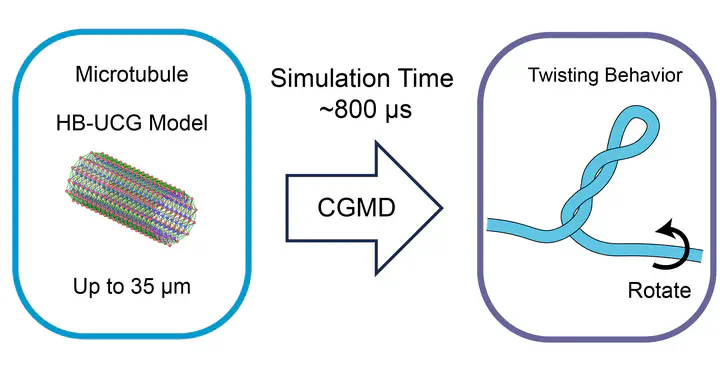
Microtubules (MTs) are hollow cytoskeletal polymers with exceptional mechanical rigidity and dynamic instability, distinguishing them from conventional helical polymers. Their unique biophysical properties pose significant challenges for computational modeling, particularly on biologically relevant length scales. In this study, we developed a helix-based ultra-coarse-grained (HB-UCG) model for MT dynamic simulation, based on the electron microscopy density data of helical MTs. Using this model, we constructed MTs of up to 35 μm in length and investigated the relationship between the persistence length and contour length. Validation against experimental data confirmed the HB-UCG model’s ability to simulate MT mechanical properties accurately. Additionally, we performed coarse-grained molecular dynamics (CGMD) simulations approaching the millisecond scale, capturing the formation of kinks through MT twisting and quantifying the associated shear strains. We also simulated the helicity of a single MT and compared it with the experimental values of MT bundles, suggesting that inter-MT interactions have an important influence on the helicity of the MT bundles. Our work provides a valuable CG model for studying micrometer-scale MT dynamics in cellular environments.
Renjie Zhu
PhD Student in Chemistry
Hi, I am Renjie Zhu (朱 仁杰), a PhD student in Chemistry at Boston University. I received my Bachelor of Science degree in Chemistry from East China Normal University in 2025, where I spent four unforgettable and rewarding years. My given name shares the same Chinese characters as Di Renjie, a legendary detective figure. Therefore, I want to become a “detective” in the scientific world, using computational approaches to uncover the hidden mechanisms underlying chemical and biological systems.